

Global Coordination: One Planet, Many Projects
Avoiding duplication, amplifying impact.
With genome projects spanning continents and taxa, coordination is essential. This section examines how global networks can collaborate efficiently, share progress transparently, and ensure that collective efforts add up to more than the sum of their parts.
How can global networks collaborate more efficiently without duplicating effort?
Mark Blaxter: We have built a collaborative system, called Genomes on a Tree (GoaT) that lets projects declare what they are interested in, the species they intend to sequence, and their progress in sequencing their targets. Using this information, projects can quickly work out how their desiderata lists overlap, and work out mutually beneficial synergies to meet their goals together.
It’s thus important that new projects get themselves onto GoaT as soon as possible, and that existing projects keep GoaT updated as to their progress. The most efficient genome project ever has to be the one where you look it up on GoaT and discover someone else is just ready to release it to you!

Mark Blaxter, happily hoping that all EBP-affiliated projects feed their data into GoaT today—the more data GoaT ingests, the more powerful downstream EBP analyses become.
How could tools like GoaT evolve to support the next phase of global coordination as biodiversity genomics continues to scale?
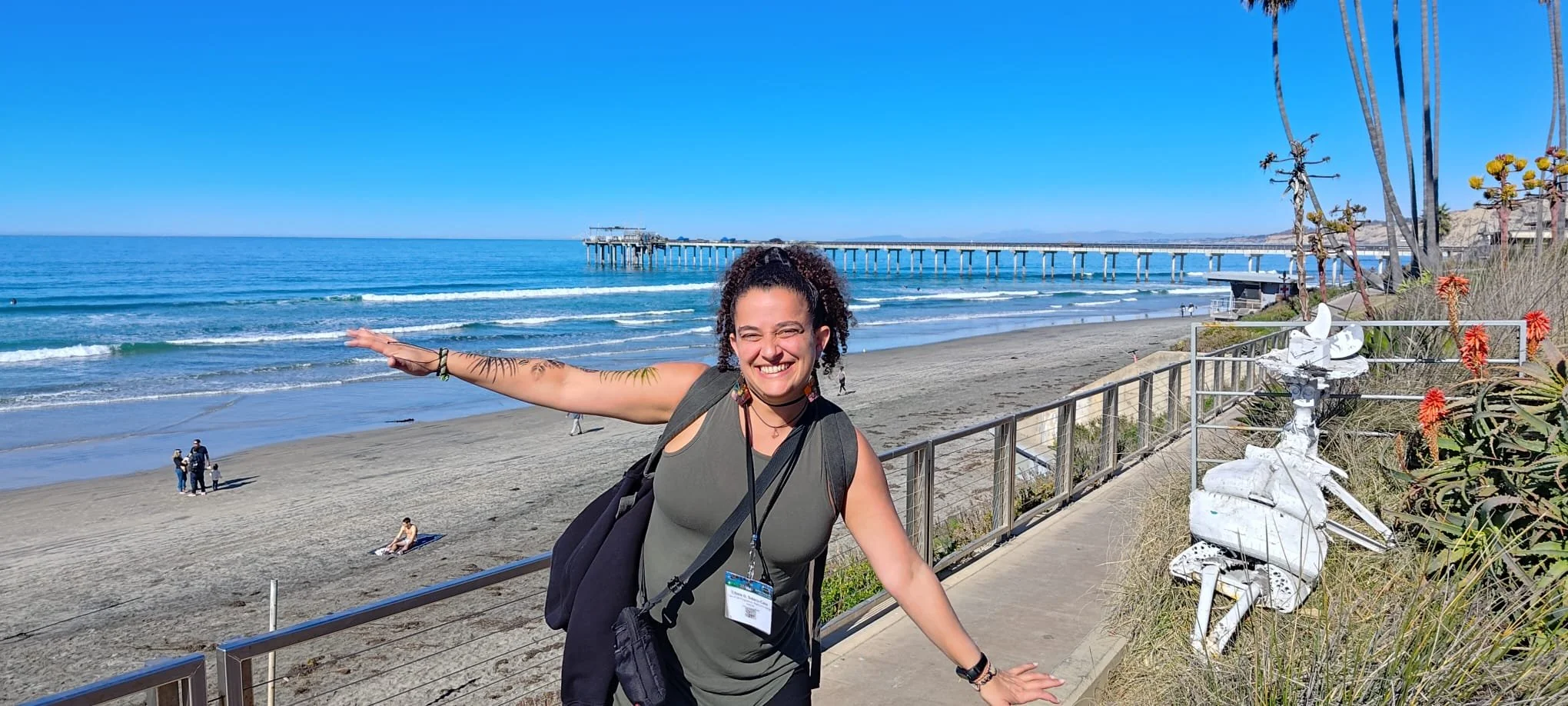
Cibele Sotero-Caio celebrating the latest GoaT imports at La Jolla Shores Beach, San Diego, USA.
Cibele Sotero-Caio: Successful tools must respond to the rapid shift and increase of the amount and flow of information that accompanies scaling. With that in mind, GoaT was designed as a flexible tool that evolves according to the data it receives. The potential of GoaT to adapt to scaling can be summarized in four main axes:
Adapting to taxonomy changes. “GoaT is built on top of a backbone taxonomy (NCBI taxonomy, which has the set of eukaryotic species for which there is genetic data), where all taxa are there and ready to accept available data”. As phylogenomic studies correct relationships and the backbone taxonomy is modified, GoaT is able to pick up the changes overnight, find and distribute the metadata from all of its sources.
Improving data accuracy. GoaT handles missing data as estimates, computed as the summary of all available data for all species sharing a most recent common ancestor. As additional taxa/ metadata is fed to GoaT, it recalculates those summaries, improving available estimates.
Adjusting to data relevance. GoaT is ready to accept any type of data that can aid in planning and prioritization of genome-sequencing. Input and feedback from the community is extremely valuable for us to understand what meta(data) will be important for coordination and we actively encourage users to reach out to propose new fields and sources.
Resilience to increased data flow. Another aspect of scaling as the amount of data increases, so must be the computing demands to retrieve the information. GoaT data model and database implementation makes it very fast now, but also supports a lot more data. It will remain fast as data scales up!
To summarise, as the community feeds information, GoaT receives a "continuous iterative feedback” that operates as a self-correcting mechanism. It’s backend is also built to support an increase in flow of information without losing computing power.
What barriers still limit widespread use of tools like GoaT, and how could they be addressed to support global coordination at scale?
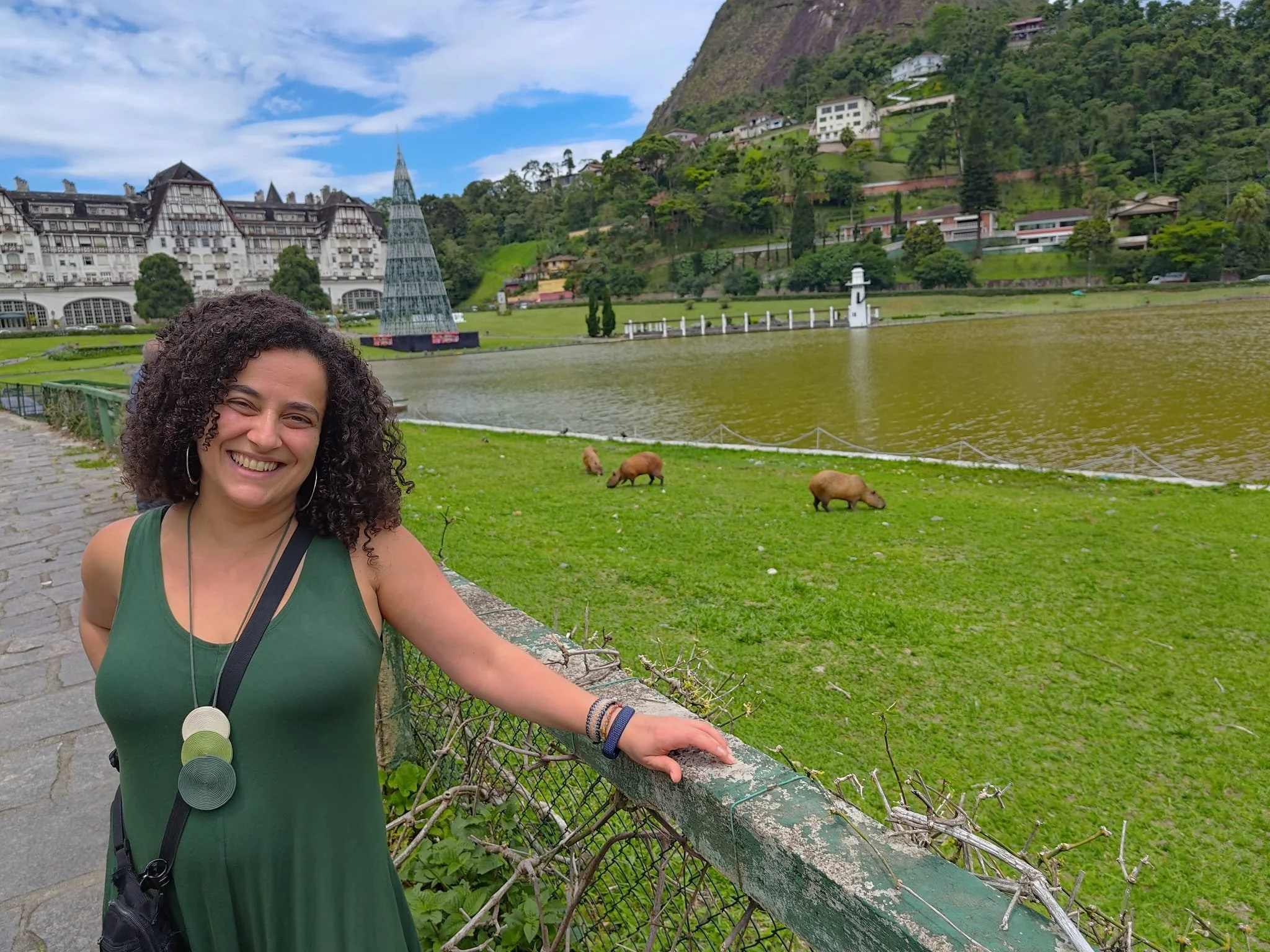
Cibele Sotero-Caio exploring the Palácio Quitandinha, Petrópolis, Brazil.
Cibele Sotero-Caio: FAIR meta(data) is essential for tools like GoaT to exist and be useful. As a sequencing project, be it submitting your genomic data to public repositories like the INSDC or reaching out to show your project's plans and progress, ensures that the metadata information is findable by GoaT and arranged so the community can make informed decisions on reusing that data or planning their own efforts. The best actions happen when the information is updated as frequently as possible.
GoaT relies on public data. We encourage scientists to deposit their metadata in specialized public databases, like sequencing repositories, genome size, chromosome number, occurrence, and vouchering databases. All sources imported into GoaT are authoritative for their kind of information, so having your data public and findable will ensure that old mistakes correct themselves over time and that GoaT estimates are increasingly accurate.
Natural language is certainly something to explore to ensure GoaT queries can be more easily interpreted. The GoaT team is investing in developments in user experience for its web interface, and also exploring the power of machine learning and LLMs to aid in GoaT queries. We envision chat-like features in the near future.
How does the EBP Secretariat help coordinate dozens of genome sequencing initiatives worldwide to reduce duplication and ensure collective impact at scale?
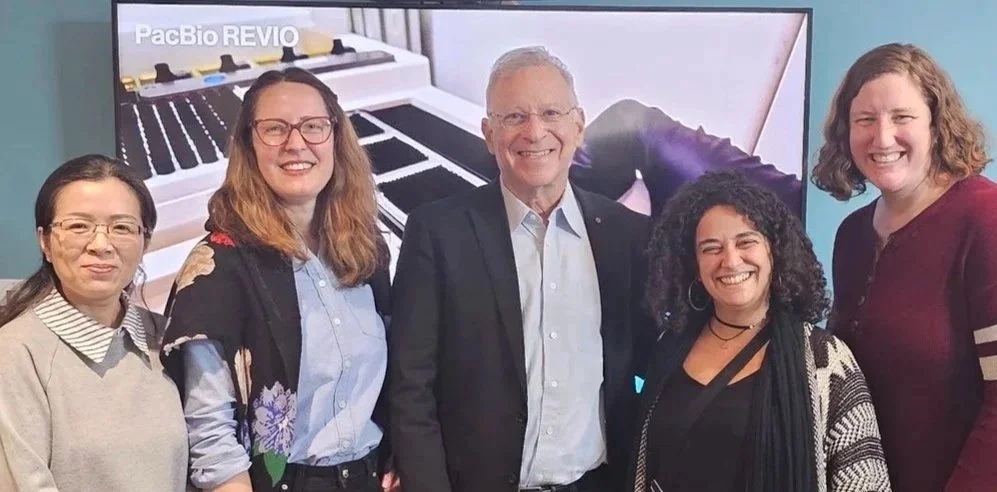
The EBP Secretariat gathered in January 2026 at Arizona State University (ASU) for our annual in-person meeting to align on long-term goals as we look ahead to EBP Phase II. From left to right, the EBP Secretariat includes: Fang Chen, Nicolette Caperello, Harris Lewin, Cibele Sotero-Caio, and Anna Bramucci.
EBP Secretariat: At the core of global coordination is visibility. Through clear communication and shared infrastructure, the EBP Secretariat works to connect large-scale biodiversity sampling efforts with genome sequencing priorities in near real time. By aligning sample metadata, project plans, and EBP reference genome targets, we help ensure that newly collected specimens are rapidly matched with sequencing teams ready to act—reducing delays and maximizing the impact of every hard-won sample.
A key role of the Secretariat is also helping the community see where the biggest gaps still lie. By enabling sampling initiatives to identify whether newly collected species lack EBP-standard reference genomes at the family, order, or phylum level, we help direct sequencing effort to where it will have the greatest global value, strengthening coordination and collective impact across projects and regions.