

Whale shark (Rhincodon typus) swimming with its mouth open to filter feed.
Q&A with Harris Lewin
What funding models make genome sequencing sustainable beyond pilot grants?
Sustaining genome sequencing beyond pilot grants requires diversified and coordinated funding models.
While large-scale sequencing inevitably demands large-scale investment, the key challenge is aligning funding with clear scientific and societal value. Traditional government agencies remain the principal sources for projects tied to defined goals—such as evolutionary biology, conservation, human health, or bioeconomy applications. For these, principal investigators must continue to justify the need for high-quality reference genomes, though falling sequencing costs have made this easier.
Philanthropic foundations and private donors are increasingly vital, particularly as they seek to support transformative research in areas like biodiversity conservation, sustainability, and the integration of genomics with AI and data science. These sources often provide flexibility for exploratory or foundational initiatives that precede or complement government programs.
For global efforts such as the EBP, sustainability depends on creating a centralized, long-term funding framework —ideally through public–private partnerships that pool resources across nations, agencies, and foundations. This model would enable stable infrastructure, data standards, and equitable access to sequencing capacity worldwide.
Establishing such a framework is challenging, but emerging initiatives in open data, digital biology, and global biodiversity policy create real opportunities. With coordinated leadership and international cooperation, sustainable, large-scale genome sequencing is within reach.
What’s the most misunderstood cost in genome sequencing?
The most misunderstood cost in genome sequencing is not the sequencing itself, but the upstream work required to obtain high-quality, well-identified biological samples. This includes field collection, taxonomic identification by experts, vouchering, and long-term biobanking. Most easily accessible species have already been sampled, yet they represent only about ~1% of the species thought to exist.
Many remaining species are exceptionally difficult to obtain. Some have not been seen in decades; others were described only once by a single taxonomist—who may no longer be available to verify identifications. Countless eukaryotic species live in remote or extreme environments such as deep-sea ecosystems, tropical canopies, or isolated mountain regions. Organizing expeditions to reach these habitats can cost far more than the sequencing itself.
These logistical and taxonomic challenges—and their substantial costs—are often overlooked when people think about “the cost of sequencing.” The Earth BioGenome Project has explicitly accounted for these realities in its budgeting model, recognizing that collecting and correctly identifying life’s diversity is the true bottleneck and the most underestimated expense in large-scale genome sequencing effort.
When you aren’t sequencing eukaryotic life, what excites you or what hobbies do you enjoy?
When I’m not sequencing eukaryotic life—or thinking about sequencing eukaryotic life—I gravitate toward the outdoors. I love hiking, cycling, and exploring new places around the world. Over 45 years in science, I’ve built a wonderful community of colleagues and friends, and visiting them has become one of the great joys of my travels.
My most passionate hobby, though, is playing the guitar. I’m a lifelong fan of ’60s and ’70s rock and a devoted Grateful Dead aficionado. I even play professionally as a lead guitarist in a seven-piece band that performs throughout the greater Sacramento area. In a funny way, guitar playing and genome sequencing feel similar to me: both offer endless opportunities to improve, experiment, and discover something new.
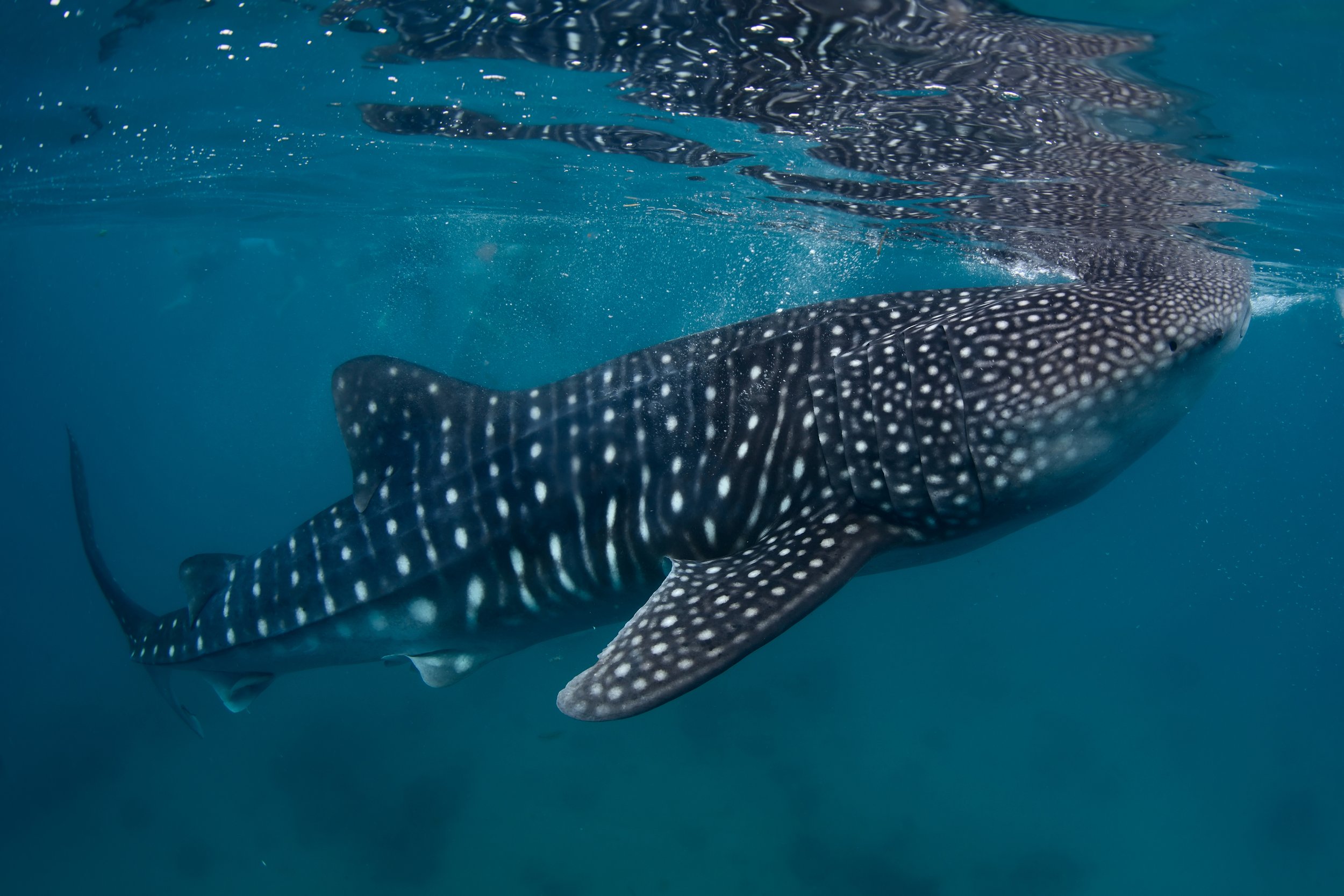
Whale shark swimming in sunlit surface waters.